
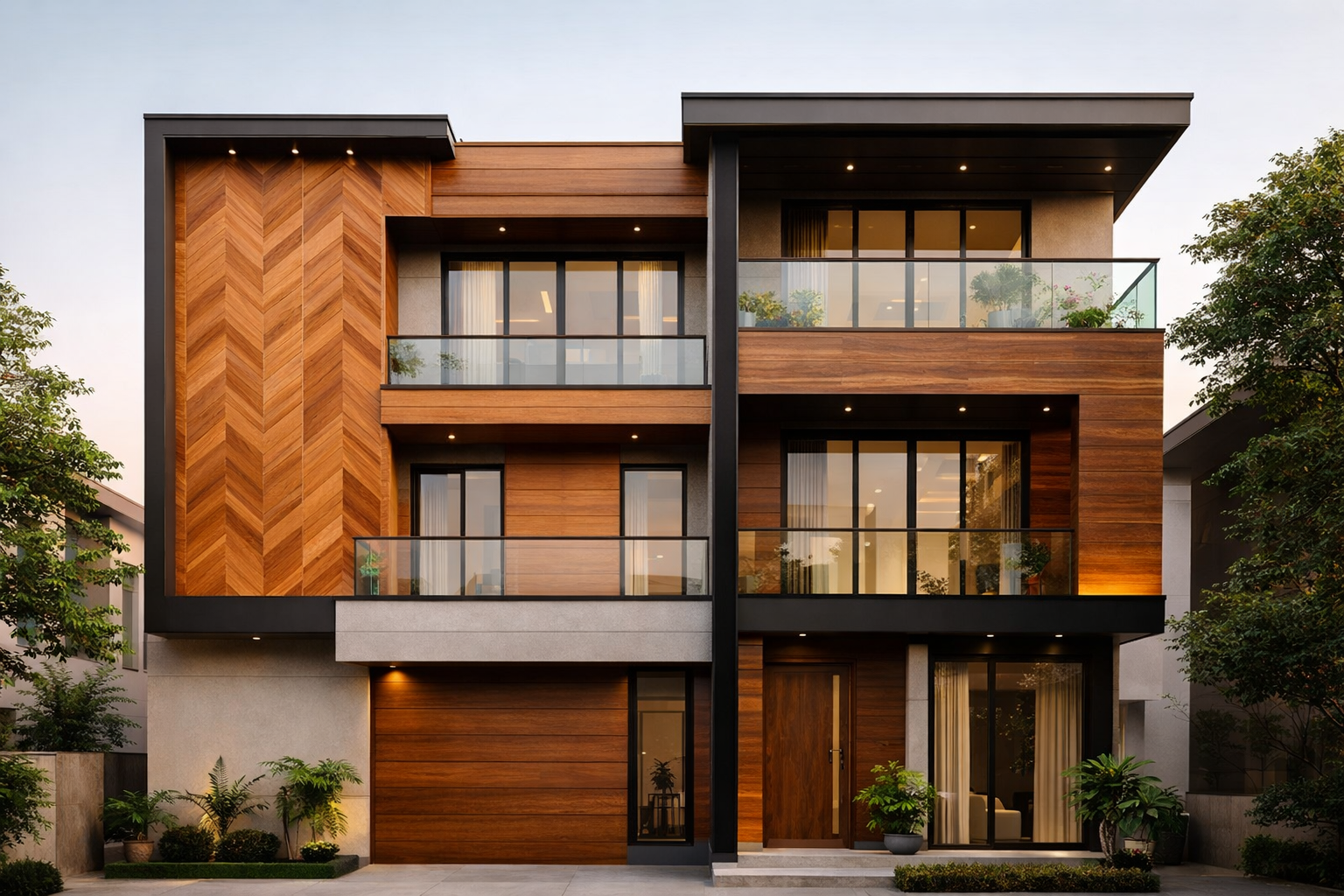
Matte black and deep charcoal have become defining exterior colours of 2026, replacing the high-gloss finishes that dominated the previous decade. They look exceptional — but on an Indian facade, dark cladding carries thermal consequences that need designing around rather than ignoring.
Why Matte, and Why Now
Current facade palettes draw from nature: bark-inspired browns, mineral beiges, soft greys and matte blacks. What unites them is that they age gracefully and integrate with stone, brick and timber rather than competing with them.
Matte specifically has displaced gloss because it reads as more architectural. A matte surface absorbs rather than reflects, so the building’s form and shadow lines become the subject instead of glare and reflections. It also hides surface imperfections and fingerprints far better at human scale.
Where Matte Black Works Best
- Accent volumes — entrance blocks, stair towers, projecting bays. Black defines a volume more sharply than any other colour.
- Framing elements — bands, reveals and fascias where you want a crisp line
- Against timber — the single most reliable contemporary pairing; black makes wood look warmer
- North and east elevations — least direct solar gain
- Commercial and retail — a black frontage makes signage and product displays read sharply
The Heat Question — Handled Honestly
Dark surfaces absorb more solar radiation. On a south or west-facing elevation in most of India, a fully black facade will run considerably hotter than a light one, and that heat has to go somewhere.
This is manageable, not disqualifying. The mitigations:
- Ventilated rainscreen construction. An open cavity behind the panels lets heated air rise and escape, so much of the absorbed heat never reaches the structural wall. This is the single most effective measure.
- Use black as accent, not field. Twenty to thirty percent of the elevation in black delivers the design effect without the whole-building thermal load.
- Place by orientation. Reserve dark surfaces for north and east faces where you can.
- Combine with shading. Deep reveals, overhangs and fins reduce direct incidence on the panel face.
An architect specifying a fully black south elevation without a ventilated cavity is making a decision the building will pay for in cooling load.
Dust: The Practical Caveat
Matte black shows dust and water streaking more readily than mid-tones, particularly in dry, dusty regions. In Rajasthan, Delhi NCR or near active construction, plan for more frequent cleaning or position black surfaces where they are less exposed to wind-driven dust.
Below window sills and projecting ledges, vertical streaking shows clearly on black. Detail drips and throatings properly.
Specification Notes
- Confirm the finish is genuinely matte, not satin — the difference is visible at scale
- Dark solid colours are more demanding on batch consistency; order the full quantity from one production run
- Check UV coating specification carefully; dark pigments are less forgiving of weak protection
- Specify surface texture where fingerprint resistance matters at ground level
Frequently Asked Questions
Is matte black cladding practical in Indian climate?
Yes, with ventilated rainscreen construction and sensible orientation. As a full south-facing facade without a cavity, it adds significant cooling load.
Does black HPL fade faster?
Dark and saturated pigments are inherently more UV-sensitive, but exterior-grade HPL with proper UV-cured coating resists fading well. Coating quality matters more than colour.
What pairs best with matte black cladding?
Wood-look finishes, natural stone, and warm metals. Black plus timber is the most reliable contemporary combination.
How much of a facade should be black?
As an accent, roughly 20 to 30 percent delivers the design effect while limiting thermal and dust drawbacks.
Specifying dark facades? Contact HPLMaker for matte solid-colour options and UV coating specifications.